
What Is Delta-8 THC?
Updated: 04/16/26
Delta-8 THC has taken the market by storm and it’s easy to understand why. As a substitute for delta-9 THC (a Schedule-I Controlled Substance per the U.S. Drug Enforcement Agency,) delta-8 THC is a hemp-derived cannabinoid that can replicate the effects of delta-9 THC causing users to feel intoxicated.
As a minor cannabinoid, there are still a lot of questions about delta-8 THC like
What is delta-8 THC?
Is delta-8 THC legal?
Will delta-8 THC make me fail a drug test?
And more….
What is Delta-8 THC?
Delta-8 THC is a psychoactive cannabinoid produced by the cannabis plant and is present in both industrial hemp and marijuana. Delta-8 THC is considered a minor cannabinoid and only appears naturally in very small (<1%) concentrations.
Because of its legally murky status and psychoactive effects, commercial hemp growers and cannabinoid extractors have utilized selective breeding, extraction techniques, and molecular manipulation to produce greater quantities of delta-8 THC.
What’s the Difference Between Delta-9 and Delta-8 THC?
Delta-8 THC is an isomer of the more common delta-9 THC cannabinoid meaning that both molecular formulas (C₂₁H₃₀O₂) are the same, but the arrangement of the atoms that make up the molecule differs.
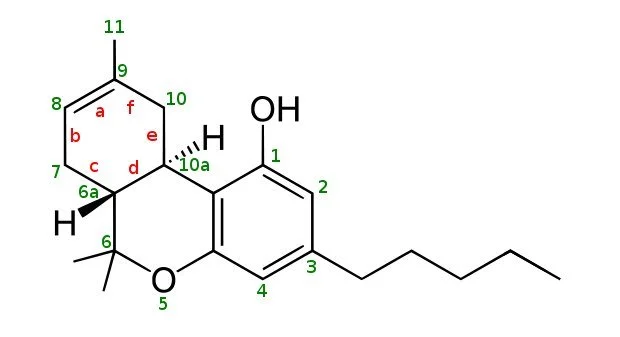
A simple model of the delta-8 THC molecule (C₂₁H₃₀O₂).
Notice the double bond between the 8th and 9th carbon atom
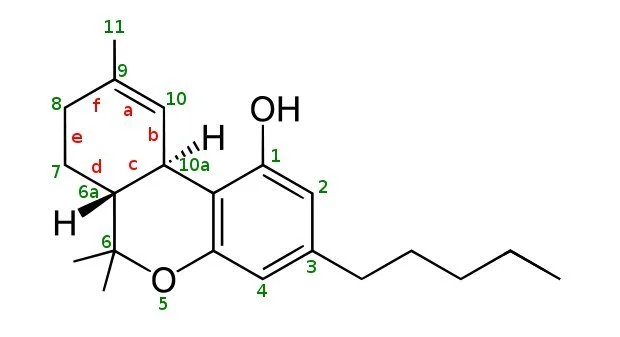
Another model. This time of the federally prohibited delta-9 THC molecule.
Contrast this model to the one above. Notice the double bond shifted over just one atom to fall between the 9th and 10th carbon atom.
While it may seem a negligible difference, this double bond placement has upended the hemp industry and has caught the attention of some lawmakers— all of which we’ll dig into below.
What are the Effects of Delta-8 THC?
Delta-8 THC users say that the intoxicating effects are similar to the effects of delta-9 THC, with some minor differences.
Users say that a delta-8 THC intoxication is less potent, more clear-headed, and more energetic than a delta-9 THC intoxication.
According to the National Cancer Institute, delta-8 THC is:
Antiemetic - a drug that helps prevent or manage nausea and vomiting.
In a 1995 study following eight pediatric cancer patients, researchers found that no vomiting occurred 24 hours after treatments when patients ingested delta-8 THC beforehand and in six-hour increments after the treatment.
Anxiolytic - a drug used to help reduce or relieve anxiety.
Appetite - stimulating
Analgesic - a drug with pain-relieving properties.
Neuroprotective - to help preserve both the neuron’s structure and function.
Why is Delta-8 THC Less Potent than Delta-9?
Delta-8’s lack of potency stems from the placement of its double bond. Whereas delta-9 THC is great at binding to our CB1 receptors— part of our endocannabinoid system— delta-8 THC isn’t as good a fit for said receptor.
That means that delta-8 THC doesn’t latch onto our receptors as readily and as a result, delta-8 THC users feel a less intense intoxication compared to a similar dose of delta-9 THC.
Does Using Delta-8 THC Have Any Side Effects?
Because delta-8 THC is considered a minor cannabinoid, there isn’t much research on its use and side effects. What we do know about delta-8 THC use is based largely on animal studies, which while helpful, don’t always give us a good idea about how a substance will affect human beings.
Is Delta-8 THC Legal?
The following is not intended to be legal advice and should not be referred to as such. Defer to your local cannabis control board or hemp regulating board for up-to-date information about the legality of delta-8 in your state.
Yes and no.
The 2018 Farm Bill reaffirmed that it was federally legal to grow, cultivate, and transport industrial hemp (cannabis with lower than 0.3% delta-9 THC by dry weight) across state lines. Judge James Gilbert ruled that products derived from hemp fell under this umbrella too the KAB vs United States Postal Service case.
Given that delta-8 THC is derived from hemp, it is okay as far as the Farm Bill is concerned. Here’s where delta-8 THC’s status gets murky.
In late 2020, the United States Drug Enforcement Agency (D.E.A.) issued an “Interim Final Rule” that stated, “ [all] synthetically derived tetrahydrocannabinol(s) remain schedule 1 controlled substances.” Barring any significant legal challenges, hemp-derived delta-8 THC may join delta-9 THC as a federally-restricted cannabinoid.
A handful of states have advanced legislation that outlaws synthetic tetrahydrocannabinol(s) derived from industrial hemp, ostensibly to get ahead of pending DEA rules, including Vermont.
In 2025, as part of the government re-opening package of bills, Congress enacted legislation that would ban most full-spectrum hemp products, and hemp-derived intoxicating cannabinoids like delta-8 THC. This ban is set to take effect on November 12, 2026 unless lawmakers make changes.
Is Delta-8 THC Legal in My State?
At the time of this writing, if you live in one of the following 24 states, you most likely can not have delta-8 THC products shipped to you.
Alaska
Colorado
Delaware
Hawaii
Idaho
Iowa
Kansas
Louisiana
Massachusetts
Michigan
Minnesota
Mississippi
Montana
Nevada
New Hampshire
New York
North Dakota
Oregon
Rhode Island
Utah
Vermont
Virginia
Washington
West Virginia
Will Delta-8 THC Make Me Fail a Drug Test?
Yes, it will.
Even though most delta-8 THC is derived from industrial hemp, urine analysis, and other generic substance-use tests are not sophisticated enough to discern between delta-9 and delta-8 THC consumption.
These tests work by detecting the presence of molecules called THC metabolites. When we consume tetrahydracannabinols, our bodies break them down into smaller compounds. These THC metabolites have unique signatures; when they’re present in the body, they signify that we’ve consumed THC.
So whether you’re taking delta-8 THC, delta-9 THC, or even full-spectrum CBD products there is a chance that these metabolites will show up during screening, regardless of the concentration, and cause you to fail a drug test.
Is Delta-8 THC Safe?
Well, that’s not really for us to say. But what we can tell you is that researchers have differing opinions about the safety of using delta-8 THC products. Research has been done on delta-8 THC for decades, but due to Federal Prohibition, the research is sparse and needs to be expanded before we can really answer the question. What scientists do seem to agree on is that while delta-8 itself might be safe for human consumption, it has the potential to come with unintended residual solvents and other chemical reaction byproducts that may not be safe.
Another aspect that puts delta-8 THC products in question is that producers often mislabel their delta-8 gummies and D8 hemp flower. An observational study published in the Journal of Studies on Alcohol and Drugs noted that the potency of products is often misrepresented.
Where Does Delta-8 THC Come From?
There are a number of ways to create delta-8 THC from industrial hemp and all of them require a bit of science, some specialized equipment, and a lot of know-how.
Warning: Delta-8 THC is created using chemical solvents and acids. The conversion process should only be performed in the safety of a well-equipped lab by knowledgeable technicians to ensure not only your own safety, but the quality and safety of the final product. You are not Walter White, do not try this at home.
Making Delta-8 THC With Solvents
To convert hemp-derived CBD isolate into delta-8 THC, you start by dissolving your isolate in sulfuric acid in glacial acetic acid. Once dissolved, let it stand at room temperature and time will do the rest. After three days your CBD converts into 15% delta-9 THC, 54% delta-8 THC, 10% delta-8-iso THC (an isomer of delta-8 THC,) and 10% CBD.
Once the conversion is complete, the solution is added to water. Sodium bicarbonate is added to that to raise the pH level.
Desired cannabinoids are extracted with petrol ether, washed with water, and heated to evaporate residual solvents. Purification to increase delta-8 THC yields and remove delta-9 from your solution can be achieved with chromatography— a method of separating liquids by passing them through a medium in which the components (CBD, delta-9, delta-8) move at different rates.
Making Delta-8 THC Without Solvents
Not a fan of solvents? Don’t worry because there’s a delta-8 THC conversion for you! Hemp-derived CBD isolate can be converted into delta-8 THC with the use of anhydrous Zinc Chloride (ZnCL₂) and an oxygen-less environment.
Heat your CBD isolate with a small amount of Zinc Chloride, apply heat, and stir. After two hours 40-50%, delta-9 and delta-8 THC will have formed from the CBD.