Cannabis Terroir: Why Sungrown Weed Carries a Sense of Place
Updated: 08/26/26
If you've ever opened a bottle of wine and noticed the label highlights its region of origin — think Napa Valley, Bordeaux, Prosecco — you've encountered the concept of terroir (pronounced "tare-WAHR"). It's a French term that translates loosely to "a sense of place," and it describes how a product's character is shaped by the natural environment in which it's grown: the soil, the climate, the topography, the sunlight, and even the human hands that tend the crop.
For centuries, terroir has been the guiding philosophy of fine wine. But cannabis terroir? As it turns out, the same idea applies! And when you grow cannabis under the open sky, in living soil, with the seasons as your clock, terroir isn't just a marketing term: it's a measurable concept.
Key Takeaways:
Terroir is "a sense of place.” Terroir is the fingerprint that a region's soil, weather, sunlight, terrain, and farming traditions leave on the finished product. No two growing sites produce identical results.
Sungrown cannabis has broader terpene diversity according to peer-reviewed research.
Environmental stressors drive terpene production. Growing plants outdoors triggers stress-response pathways in cannabis that boost aromatic compound synthesis.
Living soil matters. Beneficial fungi, bacteria, and microbial ecosystems in native soil contribute to plant chemistry in ways sterile indoor media cannot replicate.
A cannabis appellation movement is emerging in the United States. California's Cannabis Appellation Program requires outdoor cultivation, recognizing that only sungrown cannabis can truly express geographic origin.
What Is Terroir, Really?
The term terroir originates in France, where winemakers have long understood that the same grape variety grown on one hillside can produce a fundamentally different wine than grapes grown on the next hill over. Terroir encompasses the local climate, soil composition, slope & aspect (terrain), and sun exposure. All of these environmental factors that affect the taste of the final product. (1) Jancis Robinson, one of the world's most influential wine writers, famously summarized it this way: "Wine is geography in a bottle." (2) And then with each new growing season, or vintage as the winemakers call it, the wine will be slightly different due to changes in weather patterns.
But terroir isn't only about nature. Traditional winemaking and farming practices, that is the human element, are part of the definition, too. As the wine writers Hugh Johnson and Robinson emphasize in The World Atlas of Wine, terroir includes "the human hand that reads all of it together." (2) It's the relationship and the interactions between the land, the growing season, the people, and the crop itself.
How Terroir Applies to Cannabis
Cannabis, like wine grapes, is an agricultural crop that responds profoundly to its environment. The concept has gained traction in the cannabis world thanks in part to the Ganjier certification program, a rigorous cannabis sommelier training that includes a dedicated terroir module modeled after wine education programs for sommeliers. (3) The late Frenchy Cannoli, a revered hashish maker and Ganjier instructor, championed the idea:
"Plants with limited adaptability, like most agricultural crops, convey the characteristics of a specific terroir; the cannabis plant goes beyond — it becomes the terroir." (4)
So what exactly shapes a cannabis plant's terroir? Let’s explore several key factors that work in concert.
Soil composition
The physical and chemical makeup of the soil, whether it be clay, loam, sand, silt, and its organic matter and mineral content, directly influences the nutrients available to the plant and the microbial communities that live in the root zone. Living soil teeming with beneficial fungi and bacteria produces different results than the sterile, inert growing mediums used for indoor marijuana growing.
Climate and weather
Temperature ranges, rainfall, humidity, wind, and the duration of the growing season all leave their mark on the cannabis plant. Diurnal temperature swings (the difference between daytime highs and nighttime lows) are particularly important, as they stress the plant in ways that can concentrate terpenes and cannabinoids.
Sunlight
Full-spectrum natural sunlight, including UV-B radiation that artificial grow lights cannot replicate, triggers stress-response pathways in the plant that boost terpene production. A 2023 study found that genetically identical cannabis plants grown outdoors produced significantly richer and more diverse terpene profiles than their indoor counterparts. Some terpenes appeared only in the sun-grown flowers. Further research published in the journal Molecules confirmed these findings, showing that outdoor-grown cannabis demonstrated a broader range of terpene compounds compared to genetically identical plants cultivated indoors under artificial lighting. (5)
Topography and aspect
The slope, elevation, and orientation of a growing site affect drainage, sunlight exposure, air circulation, and frost risk. Even subtle differences in the lay of the land can change how a plant expresses itself.
Microbial life
The microscopic ecosystem in and around the plant, such as fungi, bacteria and other microorganisms, forms what scientists call the plant's holobiont. This living web interacts with the plant to shape its growth, resilience, and ultimately the chemical profile of the harvested flower.
Farming cultural practices
The farmer’s cultural practices — that is, how they approach farming — has a large impact on the character of the final cannabis flower. Their choice of soil amendments (i.e., fertilizers), whether they choose to water or not, their pest management systems, pruning techniques, trellising, and harvesting methods all come into play. And then after harvest, how the farmer chooses to dry and cure the marijuana flower helps to lock in the terroir. Properly aged and cured cannabis, like a well-aged wine, allows the fullest expression of the place where it was grown. (6)
Why Sungrown Cannabis Has More Terroir Than Indoor
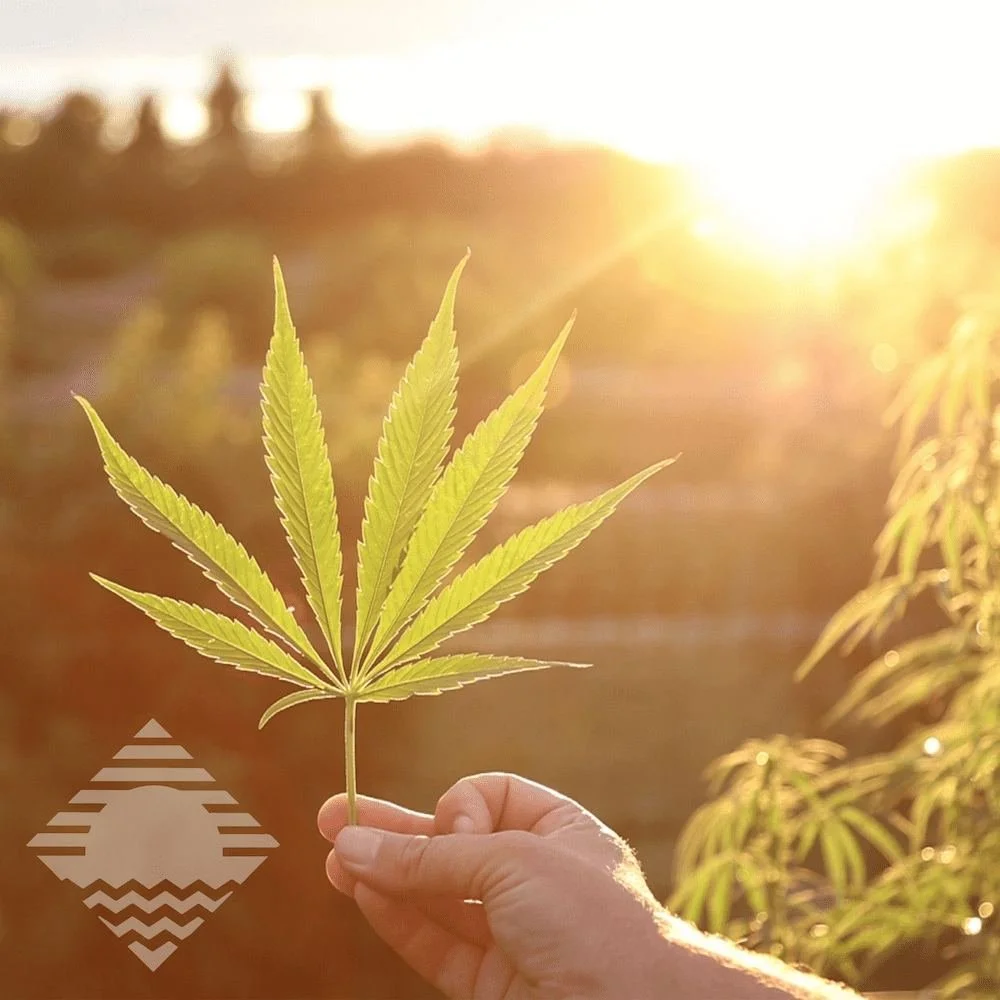
Indoor cultivation excels at repeatability. Dial in your temperature, humidity, lighting schedule, and nutrient ratios, and you can produce the same flower in January as in July. But what you gain in predictability, you lose in distinctiveness. Those uncontrolled variables are precisely what give a crop its regional character and sense of place.
The case for sungrown cannabis terroir is straightforward: weather, native soil, wind, rainfall, and diurnal temperature shifts cannot be simulated. They can only be experienced. An indoor facility replaces environmental complexity with an engineered stand-in, and the resulting flower — however potent or visually flawless — carries no signature of place.
Outdoors, the plant answers to its surroundings. Living soil feeds it. Unfiltered sun drives it. Storms, dry spells, and cool nights push its chemistry in directions that no grow tent can replicate. What you harvest is a flower that tastes, smells, and feels like where it came from.
Read more about Energy Needs Of Indoor vs. Sungrown Cannabis
Cannabis Appellations
This is why the emerging cannabis appellation movement matters. California's Cannabis Appellation Program, modeled on wine's protected designations of origin, aims to give regional cannabis the same geographic prestige that "Napa Valley" confers on a Cabernet Sauvignon. The program requires outdoor cultivation as a terroir baseline, recognizing that only sungrown cannabis can truly carry the signature of a place. (7) California’s Emerald Triangle which encompasses Humboldt, Mendocino, and Trinity counties, has been heralded as one of the top cannabis producing regions on the planet for over fifty years. (8)
Vermont’s Terroir Movement
Here in the Green Mountain State, Vermonters have been growing heady nugs for decades. Vermont’s kind bud is world-renowned for its aroma, flavor, and potent effects. Codifying a Vermont cannabis appellation would help protect Vermont’s reputation and help cannabis farmers as we slowly move toward interstate cannabis commerce. (9)
In a future blog post we’ll discuss how the terroir of the Champlain Islands influences Sunset Lake Cannabis products, from the sungrown cannabis flower in our BTV Blunts, to the cannabis concentrates in our vape carts, and even how it plays a role in our High Branch Sparkling Cannabis Cider which is made with apples grown here in South Hero!
Winemakers in Vermont are already on their way to establishing an official Vermont wine appellation based on our unique terroir. Vermont vineyard owners and the Vermont Grape and Wine Council have filed a petition with the federal government to create a new American Viticultural Area (AVA) called the Champlain Valley of Vermont region. (10) We’re rooting for our South Hero neighbors at Snow Farm Vineyard, and all of the Vermont wineries, to receive the recognition they deserve!
Terroir, Terpenes, and the Entourage Effect
The practical expression of terroir in cannabis comes largely down to terpenes — the aromatic compounds produced in the trichomes that give each strain its distinctive smell and flavor, and that work synergistically with cannabinoids in what scientists call the entourage effect. A sungrown cultivar testing at 18% THC with a complex, rich terpene profile can deliver a more nuanced and satisfying experience than an indoor flower at 25% THC with a flat, one-dimensional terpene profile.
When you smoke or vaporize sungrown cannabis, you're not just consuming a commodity product. You're actually experiencing a place and its terroir: the soil, the sun, the air, the water, and the farming cultural practices that brought it to life.
The Future of Cannabis Terroir
The cannabis industry is at the beginning of the same journey wine took decades ago — educating consumers that place matters, that method matters, and that the cheapest or most potent option isn't usually the best… for the consumer or for the environment! Regenerative, sungrown farms are leading the way, proving that cannabis can be grown in harmony with the land while delivering exceptional quality. Here at Sunset Lake Cannabis, our farm is Sun+Earth Certified, an industry standard that verifies our organic, regenerative farming practices.
As more consumers learn to appreciate terroir, the demand for authentic, regionally-distinct, sungrown cannabis will only grow. And when you taste the difference — when you can smell and feel the Green Mountain State terroir in a single hit — you'll understand why sungrown Vermont weed offers a pure expression of our land. 🌱 🌞
References
Puckette, Madeline. “Terroir Definition for Wine.” Wine Folly, winefolly.com/tips/terroir-definition-for-wine.
Johnson, Hugh, and Jancis Robinson. “The World Atlas of Wine.” 8th ed., Mitchell Beazley, 2019.
Coleman, Genine, and Kristen Garringer. “Terroir & Appellations of Origin.” Ganjier.
“Cannabis terroir 101: The essence of origin and flavor.” WeedMaps, https://weedmaps.com/learn/the-plant/cannabis-terroir.
Zandkarimi, Fereshteh, et al. “Comparison of the Cannabinoid and Terpene Profiles in Commercial Cannabis From Natural and Artificial Cultivation.” Molecules, vol. 28, no. 2, Jan. 2023, p. 833. https://doi.org/10.3390/molecules28020833.
Szymczak, Peter. “Cannabis Terroir 101: What Is It, and What Factors Affect It?” Leafly, 19 Sept. 2022, www.leafly.com/news/growing/cannabis-terroir-outdoor-growing.
“Cannabis Appellations Program (CAP).” California Department of Food and Agriculture. https://www.cdfa.ca.gov/oars/cap/
“Cannabis Gets Its Own Wine Country: Inside California’s Appellation System for Weed.” Budpedia, 16 Apr. 2026, budpedia.com/articles/california-cannabis-appellations-terroir-weed-wine-2026.
Angell, Tom. “Vermont Governor Signs Bill to Double Legal Marijuana Possession Limit and Allow Interstate Commerce.” Marijuana Moment, 20 June 2026, www.marijuanamoment.net/vermont-governor-signs-bill-to-double-legal-marijuana-possession-limit-and-allow-interstate-commerce.
Wells-Spackman, Theo. “Vermont’s Champlain Valley Poised to Become a Federally Recognized Wine Region.” VTDigger, 15 Apr. 2026, vtdigger.org/2026/04/15/vermonts-champlain-valley-poised-to-become-a-federally-recognized-wine-region.